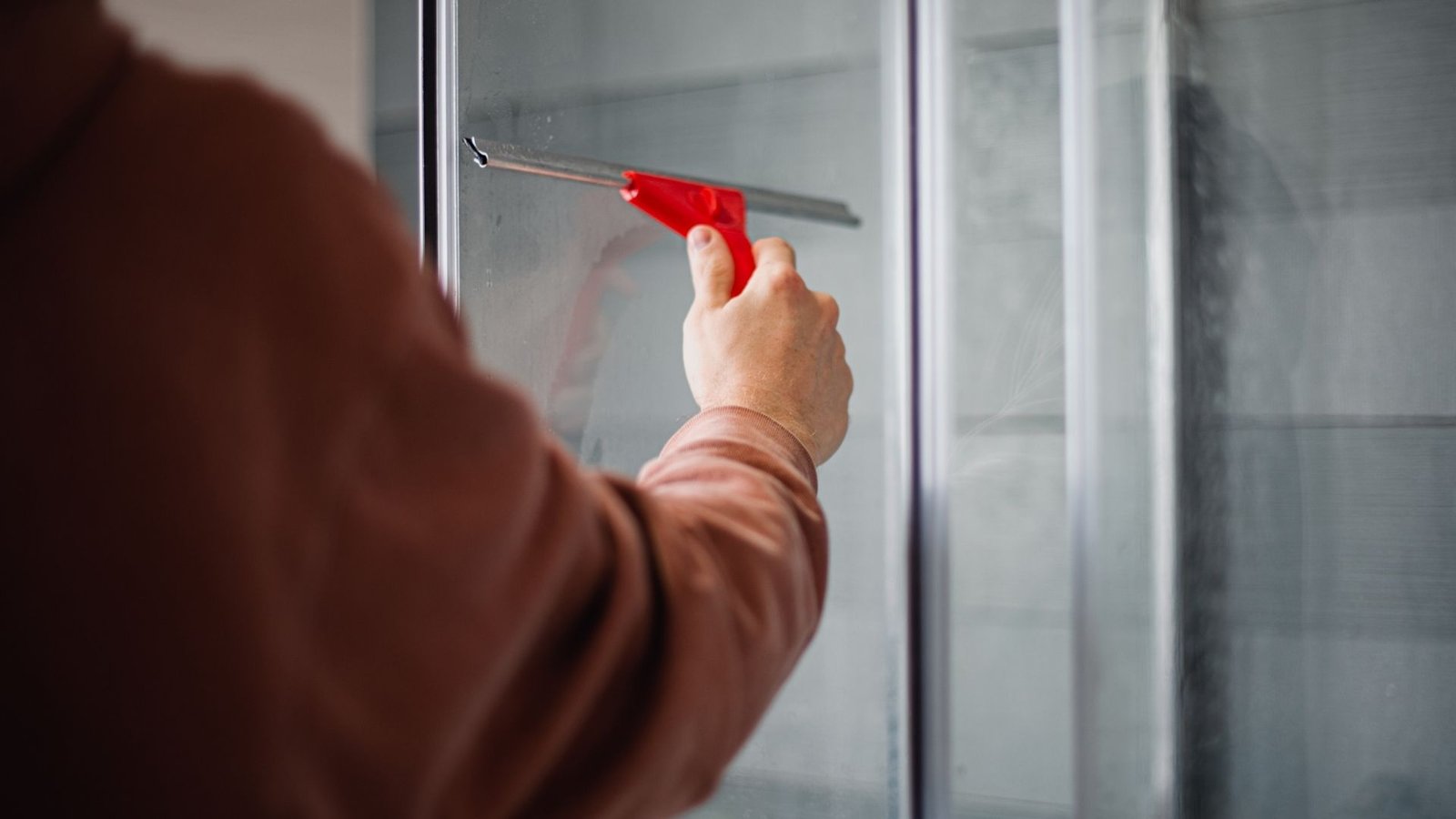
How to Remove Hard Water Stains From Shower Screens
Hard water stains on a shower screen can make an otherwise clean bathroom look dirty. Those cloudy white marks, chalky deposits and stubborn spots are usually caused by minerals left behind when water evaporates.
The longer they remain, the harder they can become to remove. Regular glass cleaner often doesn’t do much because hard water deposits aren’t simply ordinary dirt.
Fortunately, you can usually tackle them yourself with a few inexpensive household supplies and the right technique. In this guide, we’ll look at how to remove hard water stains from shower screens, what causes them, which cleaning methods work best, common mistakes to avoid and how to stop the stains returning.

What Causes Hard Water Stains on Shower Screens?
Hard water contains dissolved minerals, particularly calcium and magnesium. When water droplets land on your shower screen and evaporate, those minerals can remain behind on the glass.
At first, the deposits may look like small white spots. Over time, repeated exposure to water can create a cloudy film that becomes increasingly difficult to remove.
The problem is often worse when:
- Water is allowed to dry naturally on the glass
- The shower screen isn’t regularly cleaned
- The bathroom has poor ventilation
- Mineral-rich water is present
- Soap and shampoo residue combine with mineral deposits
- The glass isn’t dried after showering
Hard water deposits aren’t necessarily a sign that your bathroom is dirty. They are largely a result of what is contained in the water.
The important thing is to remove them before they become heavily established.
What You Need to Remove Hard Water Stains
You don’t need an expensive collection of specialist cleaning products.
For mild to moderate deposits, you can start with:
- White vinegar
- Warm water
- A spray bottle
- Microfibre cloths
- A non-abrasive sponge
- A soft cleaning brush
- Rubber gloves
- A squeegee
A commercial limescale or hard-water remover can also be useful when deposits are particularly stubborn. If you use one, always read and follow the manufacturer’s instructions and check that it is suitable for glass and any surrounding materials.
Before You Start
Remove bottles, razors and other items from the shower area so you can work safely.
Open a window or switch on the bathroom exhaust fan if appropriate. Even relatively mild cleaning solutions can produce unpleasant vapours in a poorly ventilated room.
Never mix different cleaning chemicals together. In particular, never mix acidic cleaners such as vinegar with bleach or other incompatible products.
How to Remove Hard Water Stains From Shower Screens With Vinegar
For ordinary mineral deposits, diluted white vinegar is a practical starting point.
Vinegar is acidic, which means it can help break down mineral deposits on suitable surfaces.
Step 1: Remove Loose Dirt
Before treating the hard water stains, rinse or wipe the shower screen to remove loose dirt, hair and soap residue.
This matters because you’re trying to treat the mineral deposits rather than simply spread grime around the glass.
If the screen is particularly dirty, clean it first with a suitable glass or bathroom cleaner and rinse away any residue.
Step 2: Make a Diluted Vinegar Solution
Mix approximately equal parts white vinegar and water in a spray bottle.
For example, you could use one cup of white vinegar with one cup of water.
For heavier deposits, some people use a stronger vinegar solution, but start with the diluted mixture rather than assuming stronger is always better.
Label the spray bottle clearly if you intend to keep the solution.
Step 3: Apply the Solution to the Glass
Spray the solution over the affected areas.
Don’t allow the solution to simply run down the entire bathroom unnecessarily. Concentrate on the areas showing mineral deposits.
For stubborn marks, place a vinegar-dampened microfibre cloth over the affected area so the solution remains in contact with the deposit for longer.
Step 4: Let It Work
Allow the solution to sit for several minutes.
The purpose of this waiting period is to give the acidic solution time to work on the mineral deposits.
Don’t allow cleaning products to dry completely on the glass. If the surface starts drying, apply a little more solution.
Step 5: Gently Scrub the Deposits
Use a non-abrasive sponge or soft cloth to work over the stained areas.
Don’t attack the glass with a harsh scouring pad. Scrubbing harder isn’t necessarily better, and abrasive materials can damage some glass surfaces or coatings.
Work systematically across the screen.
Step 6: Rinse Thoroughly
Once the deposits have loosened, rinse the glass thoroughly with clean water.
This removes loosened mineral residue as well as the vinegar solution.
Pay attention to the edges, seals and surrounding surfaces.
Step 7: Dry the Glass
Use a clean microfibre cloth to dry the shower screen.
A squeegee can also be extremely useful for removing water from the glass before finishing with the cloth.
This final step is more important than it might seem.
If you leave a wet shower screen to air-dry, you’re giving dissolved minerals another opportunity to remain on the glass.
How to Remove Stubborn Hard Water Deposits
Some shower screens have years of accumulated mineral deposits.
In that situation, one cleaning session may not be enough.
Instead of using increasingly aggressive scrubbing, repeat the cleaning process. Apply the vinegar solution, allow it time to work, gently agitate the surface and rinse thoroughly.
For particularly stubborn limescale, a commercially manufactured descaling product may be more effective.
Check the Product Before Using It
Read the label carefully.
Some bathroom surfaces can be damaged by acidic cleaners, particularly certain natural stones and sensitive finishes. Keep the product away from surfaces for which it isn’t approved.
If your shower has stone tiles, marble, limestone or another acid-sensitive material, don’t assume a vinegar solution is safe simply because it works on glass.
The glass screen may tolerate the treatment while the surrounding surface does not.
When using a commercial product, follow its instructions rather than combining it with another cleaner.
Can Baking Soda Remove Hard Water Stains?
Baking soda is commonly suggested for bathroom cleaning, but it isn’t always the best first choice for shower glass.
Baking soda is mildly abrasive and can help with some types of grime. However, hard water deposits are mineral-based, so an acidic cleaner is generally more appropriate for dissolving mineral buildup.
If you use baking soda, avoid aggressive scrubbing.
A gritty paste and heavy pressure can potentially scratch or damage some surfaces and finishes.
For straightforward mineral deposits on ordinary glass, start with a suitable limescale treatment rather than relying on abrasive action.
What About Lemon Juice?
Lemon juice is acidic and can help with some mineral deposits.
However, it’s generally less convenient than white vinegar for cleaning a large shower screen because you’ll need a considerable quantity to cover the affected area.
A properly used commercial limescale remover may be a better option for heavy deposits.
The important principle is the same: use a suitable acidic cleaner to help break down mineral deposits, then rinse and dry the glass thoroughly.
Common Mistakes When Cleaning Shower Screens
Removing hard water stains isn’t difficult, but several common mistakes can make the job harder.
Using Ordinary Glass Cleaner Alone
Standard glass cleaner is excellent for fingerprints, dust and some general marks.
It isn’t necessarily designed to dissolve heavy mineral deposits.
If the glass has a chalky white coating that keeps returning, you’re probably dealing with more than ordinary dirt.
Scrubbing Too Hard
When a stain doesn’t disappear immediately, it’s tempting to reach for a rough scourer.
Don’t.
Use the appropriate cleaning solution and give it time to work. Excessive force can damage glass, seals, finishes or protective coatings.
Leaving Vinegar on Surrounding Surfaces
Vinegar may be suitable for the glass but unsuitable for certain nearby materials.
Be especially careful around natural stone surfaces.
Wipe up spills rather than allowing cleaning solutions to sit on surrounding tiles, stone, metal finishes or seals.
Ignoring the Shower Door Hardware
Mineral deposits can accumulate around hinges, handles and metal fittings as well as the glass.
Don’t automatically use the same cleaning solution on every component.
Check the manufacturer’s care recommendations for specialist finishes and hardware.
Cleaning Without Rinsing
A cleaning solution can loosen mineral deposits, but the residue still needs to be removed.
Rinse the screen thoroughly after cleaning.
Otherwise, you may simply leave another film behind.
How to Prevent Hard Water Stains Returning
Prevention is much easier than repeatedly removing years of buildup.
The most effective habit is simple: remove water from the glass after every shower.
Use a Shower Squeegee
Keep a small squeegee inside the shower.
After showering, run it down the glass to remove most of the remaining water.
It takes less than a minute and can dramatically reduce the amount of mineral residue left behind.
Wipe the Glass Regularly
A quick wipe with a clean microfibre cloth can remove remaining moisture.
Don’t use a dirty cloth because it can redistribute soap residue and grime across the surface.
Improve Bathroom Ventilation
Good ventilation helps reduce moisture throughout the bathroom.
Use the exhaust fan when appropriate and allow the room to dry after showering.
This won’t remove minerals from the water, but it can help reduce the amount of moisture sitting on surfaces.
Clean the Screen Regularly
Don’t wait until the glass becomes heavily stained.
A quick regular clean is much easier than trying to remove a thick layer of mineral deposits several months later.
What If the Glass Still Looks Cloudy?
If you’ve removed visible deposits but the glass still appears cloudy, the problem may not be ordinary hard water staining.
Older shower screens can develop permanent etching or surface damage after prolonged exposure to mineral deposits.
This is different from a removable layer sitting on top of the glass.
A useful test is to clean a small area thoroughly and compare it with the surrounding glass.
If the cleaned area remains permanently cloudy, the glass itself may have been affected.
At that point, more aggressive household scrubbing is unlikely to be the answer.
A professional glass restoration service may be able to assess the surface and determine whether restoration is possible.
When DIY Cleaning Isn’t the Right Choice
Most ordinary hard water stains are suitable for careful DIY cleaning.
However, consider professional assistance if:
- The glass appears permanently etched
- The shower screen is damaged or cracked
- A specialist glass coating may be present
- You don’t know which products are safe for the glass
- Natural stone surrounds are involved
- Previous chemical treatments have been used
- A commercial descaler hasn’t solved the problem
- You are concerned about damaging an expensive shower enclosure
Never use an abrasive power tool or aggressive chemical simply to remove a stubborn stain.
The cost of replacing damaged glass or finishes can be far higher than the cost of having the problem professionally assessed.
Frequently Asked Questions
What is the best way to remove hard water stains from a shower screen?
For mild to moderate mineral deposits, a suitable acidic cleaner such as diluted white vinegar can be a useful starting point. Apply it carefully, allow it time to work, gently clean the glass, rinse thoroughly and dry it.
Does vinegar remove limescale from shower glass?
Vinegar can help dissolve mineral deposits such as limescale because it is acidic. It may be less effective on very old or heavily established deposits, where a suitable commercial descaling product may be required.
How long should I leave vinegar on shower glass?
A few minutes is generally a reasonable starting point for ordinary deposits. Don’t allow the solution to dry on the glass, and always rinse the surface thoroughly afterward.
Can I use baking soda on a glass shower screen?
Baking soda can help with some cleaning jobs, but it isn’t necessarily the best choice for mineral deposits. Because it is mildly abrasive, avoid aggressive scrubbing that could damage sensitive surfaces or coatings.
Why do hard water stains keep coming back?
The stains return because new water droplets leave minerals behind every time they evaporate. Using a squeegee after showering and keeping the glass dry can significantly reduce recurring deposits.
Can hard water permanently damage a shower screen?
Prolonged mineral buildup can sometimes contribute to glass etching or permanent-looking cloudiness. Once the glass itself has been affected, ordinary household cleaning may no longer restore its original appearance.
Can I use vinegar on the whole shower?
Not necessarily. Vinegar may be suitable for some glass surfaces but can damage or affect certain natural stone and other sensitive materials. Treat the glass separately and check the care requirements for surrounding surfaces.
Should I clean my shower screen while it is wet or dry?
Cleaning solutions are generally easier to control when applied to a reasonably clean surface. After cleaning, however, the screen should be rinsed and dried thoroughly so fresh mineral deposits aren’t left behind.
Final Thoughts
Learning how to remove hard water stains from shower screens doesn’t require expensive equipment or hours of scrubbing.
The key is understanding what you’re actually trying to remove. Mineral deposits respond differently to ordinary dirt, so using an appropriate descaling approach and allowing the cleaner time to work is usually more effective than simply scrubbing harder.
Just as importantly, prevention matters. Keep a squeegee in the shower, remove excess water after use and clean the glass regularly.
That small amount of maintenance can prevent a clean shower screen from becoming covered in stubborn white deposits in the first place.