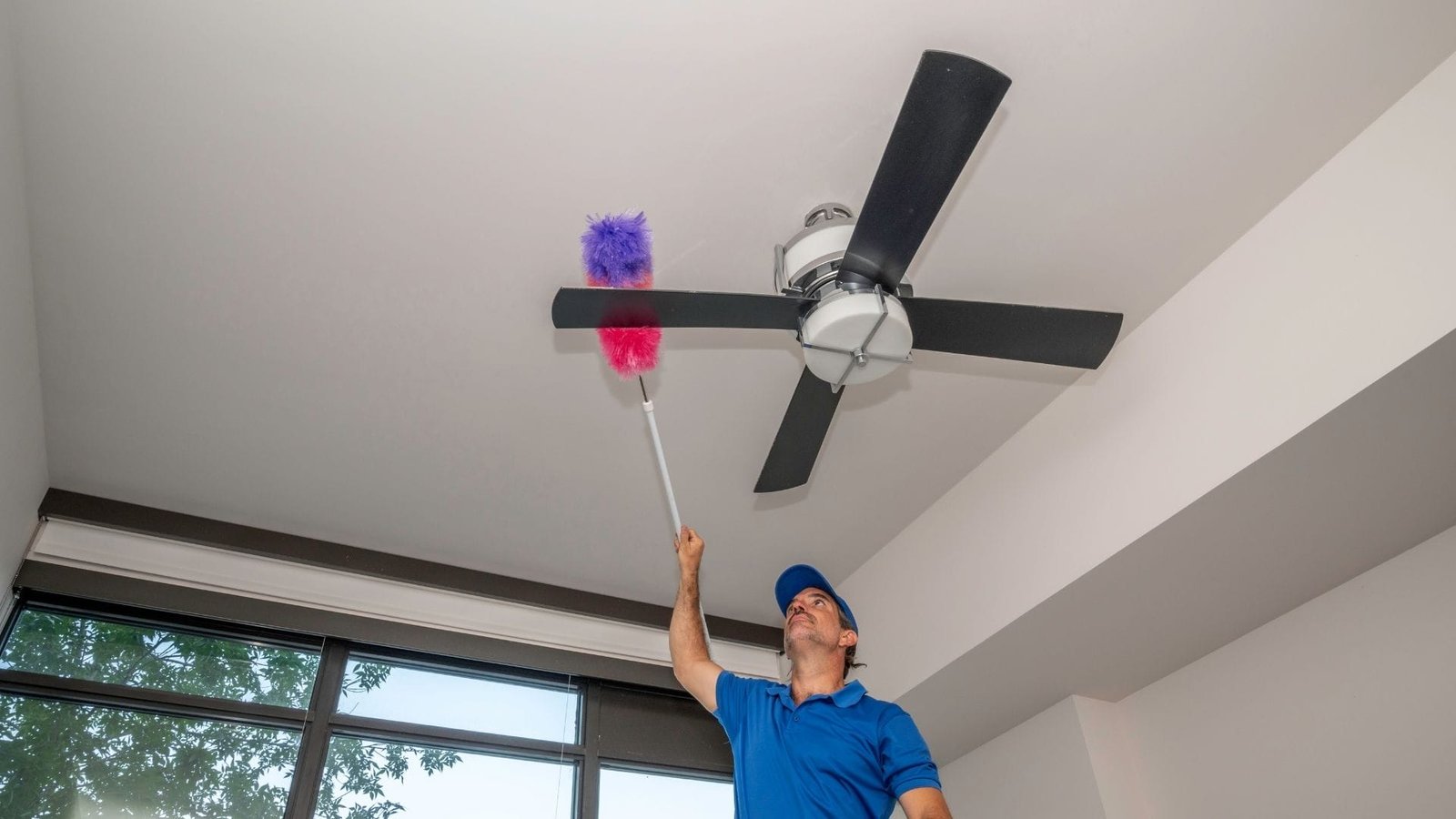
Best Way to Clean Ceiling Fans Without Making a Mess
Cleaning ceiling fans can be one of those household jobs you keep putting off. The blades collect dust, hair, grease and airborne grime, but there’s an obvious problem: if you simply wipe the blades, all that dust can end up floating around the room and settling on your furniture, floors and bedding.
Fortunately, there is a much better approach.
The best way to clean ceiling fans without making a mess is to contain the dust before it has a chance to spread. A pillowcase or similar fabric cover works particularly well because you can slide it over each blade, gently wipe the dust away and contain the debris inside the fabric.
This simple method can make ceiling fan cleaning considerably quicker and cleaner. It also means you don’t have to clean the entire room again after you’ve finished.
Here’s how to do it safely and efficiently.

Why Do Ceiling Fans Get So Dusty?
Ceiling fans constantly move air around a room. As they operate, airborne dust and small particles can settle on the blades.
When the fan is switched off, you may notice a layer of dust sitting along the upper surface of each blade.
Other things can accumulate there too, including:
- Pet hair
- Cooking grease
- Pollen
- Cobwebs
- Fine dirt
- Household dust
- Insects and insect debris
Kitchens can be particularly challenging because airborne cooking oils can make dust stick to fan blades.
Fans in bedrooms and living rooms may collect more ordinary household dust, while fans in areas exposed to outdoor air may accumulate pollen and other particles.
The Best Way to Clean Ceiling Fans Without Making a Mess
For ordinary household dust, one of the easiest methods is to use an old pillowcase.
You’ll need:
- An old pillowcase
- A step ladder or stable platform if necessary
- A microfibre cloth
- A suitable household cleaner
- A vacuum cleaner
- Optional disposable gloves
The pillowcase acts like a dust catcher.
Instead of wiping the exposed blade and allowing the dust to fall onto the floor, you place the pillowcase over the blade and gently wipe it.
The dust stays inside the pillowcase.
It’s simple, inexpensive and particularly useful when cleaning fans above beds, sofas or dining tables.
Step 1: Turn the Ceiling Fan Off
Before cleaning anything, turn the fan off.
Do not attempt to clean moving fan blades.
For additional safety, switch off the power to the fan at the appropriate isolation point if your fan’s design or manufacturer’s instructions call for it.
If the fan has a light, make sure it cannot accidentally be switched on while you’re working.
Wait until the blades have completely stopped moving.
Safety comes before speed.
Step 2: Protect the Area Below
One of the biggest advantages of the pillowcase method is that it helps contain dust.
However, it’s still sensible to protect the area underneath the fan.
Move furniture if practical and cover anything that could be affected by falling dust.
If you’re cleaning a fan above a bed, for example, you don’t want dust landing on freshly washed bedding.
For particularly dusty fans, place an old sheet or towel over the furniture underneath.
This takes a minute but can save you cleaning the area twice.
Step 3: Choose the Right Pillowcase
An old cotton pillowcase works well.
It should be large enough to slide over the fan blade without requiring excessive force.
Don’t use a valuable or delicate pillowcase.
The fabric will collect dust and may become quite dirty.
If the fan blades are heavily soiled with grease, you may prefer to use a dedicated cleaning cloth instead of relying solely on the pillowcase.
Step 4: Slide the Pillowcase Over the Blade
With the fan stationary, carefully slide the pillowcase over one blade.
The fabric should cover the blade from above and below.
Don’t pull aggressively.
If the blade feels loose or moves unexpectedly, stop and check the fan before continuing.
Once the pillowcase is positioned over the blade, gently press the fabric against the upper and lower surfaces.
This traps the dust inside the pillowcase rather than allowing it to fall into the room.
Step 5: Gently Wipe the Blade
Slowly pull the pillowcase towards the end of the blade.
Use gentle pressure.
You don’t need to scrub an ordinary layer of dust aggressively.
The aim is to lift the dust from the surface while keeping it contained.
Once you’ve reached the end of the blade, keep the pillowcase closed around the dusty section as you remove it.
Repeat the process on each blade.
Don’t Rush This Step
If the fan has accumulated months or years of dust, you may need to empty the pillowcase or use a vacuum cleaner between blades.
Trying to force a huge amount of dust into the same fabric can simply spread it around.
Step 6: Deal With Stubborn Grime
Dust is easy compared with greasy residue.
If the fan is in or near a kitchen, the blades may have a sticky film caused by airborne cooking oils.
In this situation, use a slightly damp microfibre cloth and an appropriate surface cleaner.
Spray the cleaner onto the cloth rather than directly onto the fan.
This is particularly important around electrical components.
Wipe the blade gently and then use a clean, slightly damp cloth if needed to remove residue.
Finish with a dry microfibre cloth.
Don’t soak the blade.
Step 7: Clean the Motor Housing
The fan blades aren’t the only part that collects dust.
Look at the:
- Motor housing
- Mounting area
- Light fitting
- Pull chains
- Remote-control receiver area
- Ceiling canopy
- Decorative components
Use a dry or slightly damp microfibre cloth where appropriate.
Take care around electrical components.
Never spray cleaning solution directly into the motor housing, switches, wiring or other electrical openings.
If the manufacturer’s instructions specify a particular cleaning method, follow those instructions.
Step 8: Clean the Ceiling Around the Fan
Once you’ve cleaned the fan, look upward.
You may find cobwebs and dust around the ceiling canopy or where the fan meets the ceiling.
A vacuum cleaner with a suitable soft brush attachment can be useful here.
Work gently.
You don’t want to damage painted surfaces or disturb loose ceiling material.
If you notice cracking, water staining or other signs of a ceiling problem while cleaning, don’t simply cover it up. Investigate the underlying issue.
Step 9: Clean the Light Fitting
If your ceiling fan includes a light, clean it separately.
Turn the power off and allow bulbs or other components to cool before touching them.
Follow the manufacturer’s instructions for removing the light cover.
Use an appropriate cloth or cleaning method for the material.
Don’t spray liquid directly onto the fitting.
If you’re unsure how the light fitting comes apart or you notice damaged wiring, stop rather than forcing it.
Electrical repairs should be handled by an appropriately qualified professional.
What If Your Ceiling Fan Is Extremely Dusty?
Some ceiling fans haven’t been cleaned for years.
In that case, don’t immediately start wiping everything with a wet cloth.
First remove the loose dust.
A vacuum cleaner with a soft brush attachment can help reduce the amount of dust on the blades and surrounding areas.
Then use the pillowcase method to capture remaining dust.
Finally, wipe the blades with an appropriate damp cloth if necessary.
This three-stage approach works well:
Remove loose dust → contain remaining dust → clean stubborn residue.
It is much less messy than trying to wash heavily contaminated blades immediately.
What Not to Do When Cleaning Ceiling Fans
Several common cleaning methods can create unnecessary problems.
Don’t Clean a Moving Fan
Even slow-moving blades can cause injury.
Always switch the fan off and wait for it to stop completely.
Don’t Spray Cleaner Directly Onto the Fan
Liquid can run into electrical components.
Apply cleaner to a cloth instead where appropriate.
Don’t Use Excessive Water
Ceiling fans are electrical appliances.
A damp cloth is very different from soaking the fan.
Keep moisture controlled.
Don’t Use a Rough Scrubbing Pad
Abrasive materials can scratch painted, plastic, metal or decorative surfaces.
Start with a soft microfibre cloth.
Don’t Stand on an Unstable Chair
This is especially important when cleaning high ceilings.
A proper stable step ladder or appropriate access equipment is much safer than balancing on furniture.
If the fan is too high to reach safely, consider professional assistance.
How Often Should You Clean Ceiling Fans?
There isn’t one perfect schedule for every home.
A ceiling fan in a dusty environment or a home with pets may need more frequent cleaning than one in a rarely used room.
As a general routine, inspect your fans every few weeks.
If you can see dust collecting on the blades, it’s time for a clean.
A light clean every few weeks is much easier than trying to remove a thick layer of accumulated grime several times a year.
Consider cleaning fans more frequently if you have:
- Pets
- Open windows
- High dust levels
- Renovation work nearby
- A busy kitchen
- Allergy-sensitive household members
How to Keep Ceiling Fans Cleaner for Longer
Regular light cleaning is the easiest way to prevent heavy dust accumulation.
Every few weeks, quickly inspect the blades.
If there’s only a thin layer of dust, the job should take very little time.
A few other habits can help:
- Keep windows and doors clean.
- Replace or clean HVAC filters according to their instructions.
- Vacuum rooms regularly.
- Deal with cobwebs promptly.
- Clean kitchen exhaust and rangehood filters as recommended.
- Avoid unnecessary dust-producing activities indoors.
You won’t eliminate dust completely. That’s normal.
The goal is to prevent it from building up into a thick layer.
How to Clean Ceiling Fans Without Getting Dust Everywhere
If your main concern is making a mess, use this simple sequence:
1. Turn the fan off
Never clean moving blades.
2. Protect the furniture below
Use an old sheet or towel if necessary.
3. Start with the pillowcase method
Slide an old pillowcase over each blade.
4. Pull it gently across the blade
Keep the dust enclosed inside the fabric.
5. Empty or shake out the pillowcase carefully
Do this outdoors if possible.
6. Wipe stubborn marks
Use a suitable cleaner on a microfibre cloth.
7. Clean the motor housing
Use minimal moisture and avoid electrical openings.
8. Vacuum the surrounding area
This catches any remaining dust.
This approach is quick, controlled and far less messy than simply wiping dusty blades with a dry cloth.
Can You Use a Vacuum Cleaner to Clean Ceiling Fans?
Yes, a vacuum cleaner with a suitable soft brush attachment can be useful for removing loose dust.
It is particularly helpful around the motor housing, ceiling canopy and surrounding ceiling.
However, don’t press a vacuum attachment aggressively against delicate fan blades.
The pillowcase method can be easier for capturing dust from the blades themselves.
For heavy dust, using the vacuum first and the pillowcase second can work particularly well.
When Should You Get Professional Help?
Routine dusting and cleaning is normally a straightforward household maintenance task.
However, stop if you discover:
- Damaged electrical wiring
- Loose electrical connections
- Cracked fan components
- Excessive movement or wobbling
- Burning smells
- Unusual electrical noises
- Water damage around the fan
- A fan that appears unsafe to operate
Don’t attempt electrical repairs unless you are appropriately qualified and permitted to perform the work.
If the fan is mounted at a height where cleaning requires unsafe access, hiring someone to do the job is also sensible.
The purpose of DIY maintenance is to save money safely, not to create a fall or electrical hazard.
Frequently Asked Questions
What is the best way to clean ceiling fans without making a mess?
An old pillowcase is one of the easiest methods for containing dust. Slide it over each stationary blade, gently wipe the blade through the fabric and remove the pillowcase while keeping the dust contained inside.
How do you clean ceiling fan blades without dust falling everywhere?
Use a pillowcase or another suitable fabric cover around each blade. This captures much of the dust instead of allowing it to fall onto furniture and floors.
Can I use a damp cloth to clean ceiling fan blades?
Yes, if the fan and blade material are suitable for damp cleaning. Use a slightly damp cloth rather than a soaking wet one, and never allow liquid to enter electrical components.
Should I turn off the electricity before cleaning a ceiling fan?
At minimum, the fan must be switched off and completely stationary before cleaning. Depending on the fan and the cleaning task, additional isolation may be appropriate. Follow the manufacturer’s instructions and use qualified assistance for electrical work.
How often should ceiling fans be cleaned?
Inspect them every few weeks and clean them when visible dust starts accumulating. Homes with pets, open windows, high dust levels or busy kitchens may need more frequent cleaning.
Can I spray cleaner directly onto ceiling fan blades?
It is generally safer to apply an appropriate cleaner to a cloth rather than spraying directly onto the fan. This helps prevent liquid from reaching electrical components.
What is the easiest way to clean a very dusty ceiling fan?
Remove loose dust with a suitable vacuum brush attachment or carefully use the pillowcase method first. Then clean stubborn residue with an appropriate damp microfibre cloth.
How do I clean a ceiling fan over a bed without making a mess?
Use an old pillowcase over each blade and place a sheet or towel over the bed as additional protection. Work slowly so dust remains contained rather than falling onto the bedding.
Conclusion
The best way to clean ceiling fans without making a mess is to control the dust before it has a chance to escape.
An old pillowcase provides a remarkably simple solution for ordinary household dust. By covering each blade, gently wiping it and containing the debris inside the fabric, you can avoid turning a simple cleaning job into a whole-room cleanup.
For heavier grime, remove loose dust first and then use an appropriate cleaner on a microfibre cloth. Always keep moisture away from electrical components and never clean moving fan blades.
A few minutes of regular maintenance can also make a big difference. Clean your ceiling fans before dust becomes heavily built up, and the job becomes faster and easier every time.
SEO Meta Title
Best Way to Clean Ceiling Fans Without Making a Mess
Meta Description
Discover the best way to clean ceiling fans without making a mess using a simple pillowcase method, microfibre cloths and practical safety tips.
Primary Keyword
best way to clean ceiling fans without making a mess
Secondary Keywords
- how to clean ceiling fans
- how to clean ceiling fan blades
- clean ceiling fan without dust
- how to clean dusty ceiling fans
- ceiling fan cleaning tips
- cleaning ceiling fan blades
- how to clean ceiling fans without making a mess
- easiest way to clean ceiling fans
- how to remove dust from ceiling fans
- ceiling fan maintenance
- clean fan blades
- pillowcase ceiling fan cleaning
- how often to clean ceiling fans
- how to clean a very dusty ceiling fan
- ceiling fan cleaning hack
Suggested URL Slug
/best-way-to-clean-ceiling-fans-without-making-a-mess/
Suggested Category
Cleaning Home
Suggested Tags
- Ceiling Fans
- Cleaning Tips
- Home Cleaning
- Deep Cleaning
- Dust Removal
- Home Maintenance
- DIY Cleaning
- Cleaning Hacks
- Household Cleaning
FAQ Questions
- What is the best way to clean ceiling fans without making a mess?
- How do you clean ceiling fan blades without dust falling everywhere?
- Can I use a damp cloth to clean ceiling fan blades?
- Should I turn off the electricity before cleaning a ceiling fan?
- How often should ceiling fans be cleaned?
- Can I spray cleaner directly onto ceiling fan blades?
- What is the easiest way to clean a very dusty ceiling fan?
- How do I clean a ceiling fan over a bed without making a mess?
Suggested Internal Links
- How to Remove Dust From High Ceilings — Future article opportunity
- Best Homemade Window Cleaning Solution — Future article opportunity
- How to Clean Dust From Blinds Without Making a Mess — Future article opportunity
- How to Remove Cobwebs From Ceilings — Future article opportunity
- How to Clean a Greasy Kitchen Quickly — Future article opportunity
- How to Clean Air Vents and Grilles — Future article opportunity
- How to Reduce Dust in Your Home — Future article opportunity
- Complete Home Cleaning Checklist — Future article opportunity
Featured Image Idea
A realistic photograph of a homeowner safely cleaning the blades of a ceiling fan using an old pillowcase. The fan should be stationary, with the pillowcase wrapped around one blade and a clean, bright living room underneath. The image should clearly communicate the dust-containing cleaning technique without looking staged.
Supporting Image Ideas & ALT Text
1. Pillowcase cleaning method
Suggested placement: Immediately after explaining the pillowcase technique.
ALT text: Using a pillowcase to clean a dusty ceiling fan blade
2. Dusty ceiling fan blades
Suggested placement: Introduction or causes section.
ALT text: Dust accumulated on ceiling fan blades
3. Microfibre cloth cleaning fan blade
Suggested placement: Stubborn grime section.
ALT text: Cleaning a ceiling fan blade with a microfibre cloth
4. Vacuuming around ceiling fan
Suggested placement: Vacuum-cleaning section.
ALT text: Using a vacuum brush to remove dust around a ceiling fan
5. Clean ceiling fan
Suggested placement: Conclusion.
ALT text: Clean ceiling fan blades in a tidy living room